
PROTECT AGAINST CYBER RISK
Duke Executive Cybersecurity Certificate Programs
Duke Executive Cybersecurity Certificate Programs
PROTECT AGAINST CYBER RISK
Cybersecurity and Artificial Intelligence are among the most pressing challenges facing governments, corporations, and organizations worldwide. Duke University’s executive programs prepare Chief Information Security Officers (CISOs), executives, and managers with the forward-looking, interdisciplinary training they need to stay ahead of emerging threats, harness new technologies responsibly, and lead with confidence in an increasingly complex digital landscape.
Our suite of executive programs are designed to sharpen the skills of leaders in cybersecurity and emerging technologies. Through dynamic sessions led by Duke faculty, top industry experts, and a network of accomplished peers, participants gain not only cutting-edge knowledge but also actionable strategies they can immediately apply to their organizations. Explore the program that fits your goals and take the next step toward staying ahead of the curve.
AI and Cybersecurity
for Leaders
May 27 – 28, 2026
As Artificial Intelligence (AI), especially generative AI, becomes more prevalent, leaders must understand and mitigate its regulatory and operational risks.
Industrial Security Certificate Program
May 27 – 28, 2026
Understand regulatory frameworks, standards, and regulatory requirements that are key to protecting operational technology.
Cybersecurity Resilience for Leaders
May 29 – 30, 2026
With rising cybersecurity threats and ransomware attacks, leaders must understand cyber risks, navigate regulations, and restore operations after a breach.
Cloud Security Certificate Program
May 29 – 30, 2026
Gain the skills needed to mitigate security and operational risks that come with managing data and systems in the cloud.
CISO Executive Certificate Program
June 1 – 6, 2026
Develop a comprehensive and interdisciplinary framework to enable effective management and leadership of cybersecurity teams.
Cybersecurity Leadership Program
June 5 – 6, 2026
Gain skills to better execute the responsibilities of a board member of a publicly traded company in the United States.
Cybersecurity at Duke: Annual Conference
“In the Age of Resilience” – This year’s conference convenes key players and thought leaders in cybersecurity and resilience. Participants will experience an extended survey course in Cybersecurity, with conversations from leading practitioners in areas including Artificial Intelligence and SOC Transformation, Ransomware, Artificial Intelligence and Threat Actor Landscape, government and private sector cooperation, industrial control cybersecurity best practices and cybersecurity policy and law.
Whether you’re a security leader, policymaker, technologist, or researcher, this conference offers a premier space to engage with the latest challenges and innovations in cybersecurity and resilience.
Date:
October 23 – 24, 2025
Location:
Duke University, Durham
The Duke Cybersecurity Certificate Programs were developed in partnership with Paladin Capital, a leading global investor in innovative cyber and artificial intelligence companies, along with Duke University’s Pratt School of Engineering and Sanford School of Public Policy.



Program Directors
Our program directors and guest speakers are some of the world’s top experts and practitioners in fields such as cloud security, operational technology security, artificial intelligence, machine learning security and more.

Arturo Ehuan | Executive in Residence, Pratt School of Engineering
Art Ehuan is the Executive in Residence at the Pratt School of Engineering and Executive Director of the Master of Engineering in Cybersecurity Program. Previously Art served as the Vice President at Palo Alto Networks, a global cybersecurity corporation and managing director at Alvarez & Marsal, global cyber risk service management practice, an international consulting firm. See Bio

David Hoffman | Steed Family Professor of the Practice of Cybersecurity Policy, Sanford School of Public Policy
David Hoffman is the Steed Family Professor of the Practice of Cybersecurity Policy at the Sanford School of Public Policy. He also chairs the Civil Liberties and Privacy Panel for the Director’s Advisory Board for the US National Security Agency. Hoffman formerly served as the Associate General Counsel, Director of Security Policy and Global Privacy Officer for Intel Corporation. See Bio
Arturo Ehuan | Executive in Residence
Art Ehuan is the Executive in Residence at the Pratt School of Engineering and Executive Director of the Master of Engineering in Cybersecurity Program. Previously Art served as the Vice President at Palo Alto Networks, a global cybersecurity corporation and managing director at Alvarez & Marsal, global cyber risk service management practice, an international consulting firm. See Bio
David Hoffman | Professor of the Practice of Cybersecurity Policy
David Hoffman is the Steed Family Professor of the Practice of Cybersecurity Policy at the Sanford School of Public Policy. He also chairs the Civil Liberties and Privacy Panel for the Director’s Advisory Board for the US National Security Agency. Hoffman formerly served as the Associate General Counsel, Director of Security Policy and Global Privacy Officer for Intel Corporation. See Bio
Why Duke?
Our programs are specially designed by Duke experts and key industry partners, addresses the knowledge gap for CISOs, executives, and managers who might find it challenging to navigate the broader business needs of their role. Specifically tailored with consideration for US Securities and Exchange Commission (SEC) regulatory requirements, the course aims to equip CISOs, executives, and managers with the necessary insights to offer optimal cybersecurity advice and guidance to their organizations.
“It is a fantastic course specifically for nontechnical individuals. As an executive the materials that I learned are very important and will help me make better decisions.”
– 2022 CLP Participant
“The Duke CISO certificate addresses some critical unmet needs and challenges for CISOs and aspirant CISOs: one is having a baseline knowledge of crucial cybersecurity controls. “
– 2024 CISO Participant
“One key lesson I have learned is the importance of balancing specialized technical expertise with legal and regulatory knowledge, which is crucial for today’s Chief Information Security Officer (CISO). “
– 2024 CISO Participant
Engage with the Duke Cyber Community
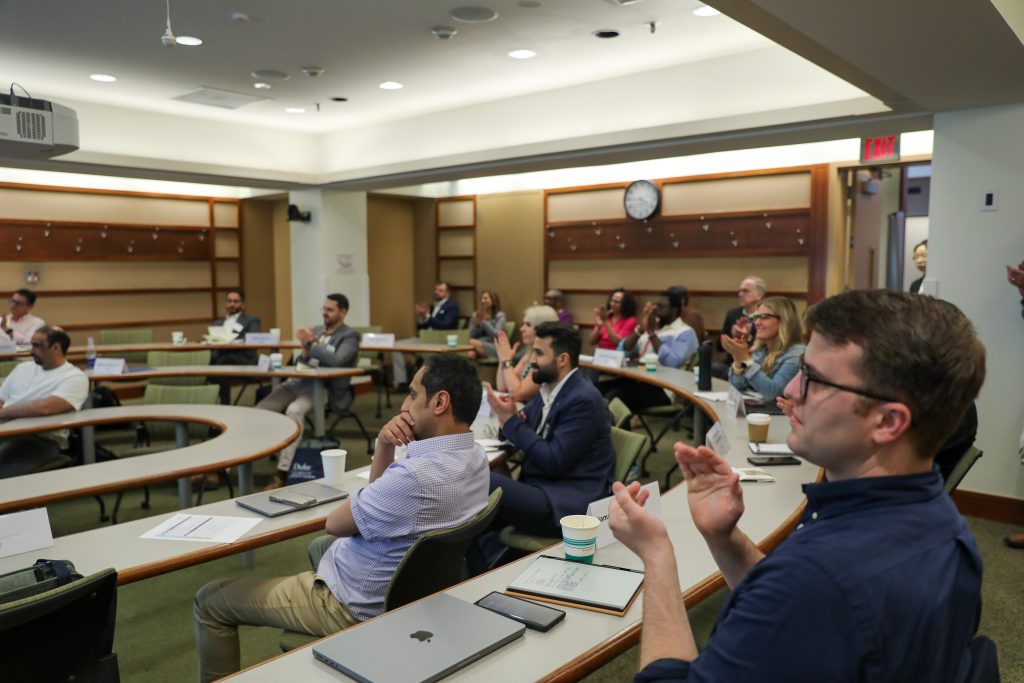
The cybersecurity world is constantly evolving with the development of new technologies. As the world grows, so do the threats to the cybersecurity space. Within Duke’s cyber community, students, faculty, and working practitioners collaborate to develop creative solutions to the cyber threats of tomorrow.
Interested in pursuing a graduate degree in cybersecurity?
Discover the Cybersecurity Master of Engineering program.
Looking to learn more about
tech policy?
Visit the Tech Policy @ Sanford initiative at Duke’s School of Public Policy
Our programs are specially designed by Duke experts and key industry partners, addresses the knowledge gap for CISOs, executives, and managers who might find it challenging to navigate the broader business needs of their role. Specifically tailored with consideration for US Securities and Exchange Commission (SEC) regulatory requirements, the course aims to equip CISOs, executives, and managers with the necessary insights to offer optimal cybersecurity advice and guidance to their organizations.
“It is a fantastic course specifically for nontechnical individuals. As an executive the materials that I learned are very important and will help me make better decisions.”
– 2022 Participant
“Every session had value and completed the mosaic needed to gain a full understanding of cybersecurity and the issues/challenges/benefits surrounding the topic.”
– 2022 Participant
“I learned new tools for cybersecurity and look forward to another course.”
– 2022 Participant
The cybersecurity world is constantly evolving with the development of new technologies. As the world grows, so do the threats to the cybersecurity space. Within Duke’s cyber community, students, faculty, and working practitioners collaborate to develop creative solutions to the cyber threats of tomorrow.
Interested in pursuing a graduate degree in cybersecurity?
Discover the Cybersecurity Master of Engineering program.
Looking to learn more about tech policy?
Visit the Tech Policy@Sanford initiattive at the School of Public Policy.
